
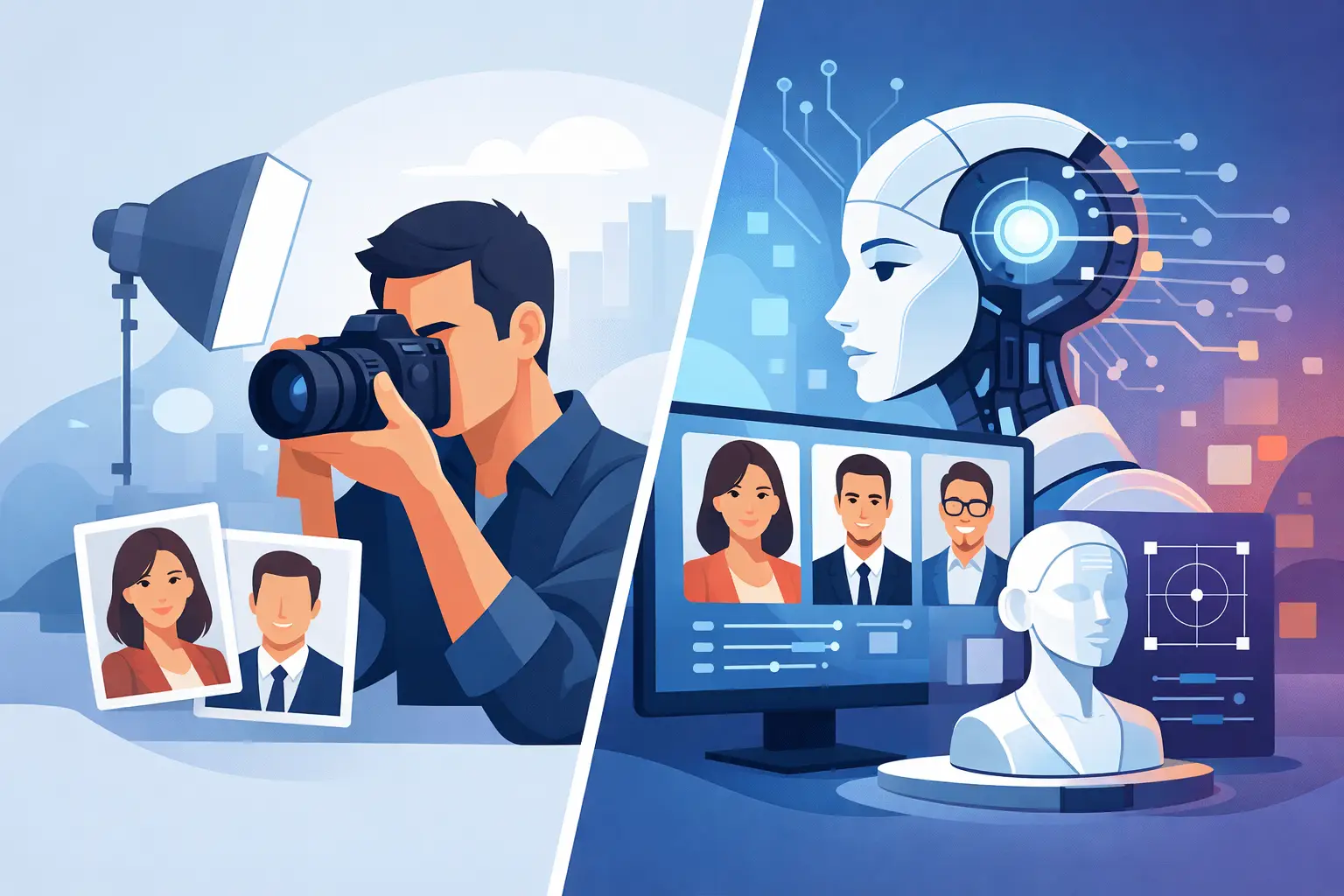
A headshot has a job to do before you ever walk into the room. On LinkedIn, a company website, a real estate listing, or an acting profile, it should make you look capable, approachable, and like yourself. That is why the choice between photographer versus AI headshots is not simply about price or speed. It is about what people see when they decide whether to contact, hire, or trust you.
AI headshot tools can be tempting. Upload a few selfies, choose a style, and receive a gallery of polished-looking images without scheduling a session. For some casual uses, that convenience may be enough. But when your image represents your career, your business, or your team, the details matter more than most people expect.
Photographer Versus AI Headshots: The Real Difference
The biggest difference is not just that one option uses a camera and the other uses software. A professional headshot session is built around you: your features, your personality, your industry, and the way you need to show up professionally. AI creates an interpretation based on the images and instructions it receives.
That interpretation can look convincing at a quick glance. It can also change small but meaningful details: the shape of your eyes, your smile, your hairline, teeth, skin texture, clothing, or even the way your face sits. You may receive an image that looks polished, but not quite like the person a client meets at a networking event or a colleague sees on a video call.
A photographer works from what is actually there. Professional lighting, lens choice, background, composition, and retouching are used to present your best real self, not replace it. The result can still be flattering and refined, while feeling familiar to the people who know you.
When AI Headshots Can Make Sense
AI headshots are not automatically a bad choice. They can be useful if you need a temporary social profile image, want to test a certain visual style, or need a quick option while planning a proper photo session. They may also appeal to someone who has a very limited budget and does not need an image for client-facing work.
The key is to be realistic about the outcome. AI is strongest when the image does not carry much weight and when a slightly artificial result will not create a problem. If you are using a photo for a private account or an internal placeholder, speed may matter more than precision.
However, AI can create images that feel overly perfected or oddly generic. A stock-like smile, a mismatched jacket, or skin that appears too smooth can quietly weaken credibility. People may not be able to explain what looks off, but they often sense it.
For professionals whose work depends on relationships, that first impression deserves more care.
What You Get From a Professional Headshot Session
A strong headshot session provides more than a finished file. It gives you direction at the point when it matters most: while you are in front of the camera.
Many people arrive convinced they are not photogenic. Usually, they simply have not been coached through a session designed for headshots. Small adjustments to posture, chin position, shoulders, expression, and where you look can change the image dramatically. A professional photographer notices these details in real time and helps you make changes without making the experience feel stiff or uncomfortable.
Lighting also does more than brighten a face. It shapes the image. The right setup can create a confident, open look for a business professional, a clean and current image for a job seeker, or more range and character for an actor or aspiring model. It can be adjusted to complement your features rather than forcing every person into the same preset style.
Then there is editing. Professional retouching should not erase every line or make your skin look plastic. It should clean up temporary distractions, refine the image, and preserve the details that make you recognizable. You still look rested, polished, and ready for your next opportunity, but you look like you.
Trust Matters More in Certain Careers
For some people, AI headshots may be a low-stakes shortcut. For others, they can introduce unnecessary risk.
Realtors, financial professionals, consultants, lawyers, recruiters, healthcare providers, and entrepreneurs often rely on trust before a conversation begins. Their face becomes part of their brand across websites, email signatures, marketing materials, and social platforms. If a prospect meets them and the photo feels noticeably different, that gap can be distracting.
Corporate teams have another consideration: consistency. A professionally planned headshot day creates a unified look across the company while allowing each employee to look natural. The same background, lighting approach, framing, and editing standard help a team page feel organized and credible. AI-generated images often vary in lighting, crop, wardrobe, and realism, even when everyone uses the same prompt.
Actors and models also need to be careful. Casting professionals want to see the real person they may bring into a room. A headshot that alters facial proportions or creates an unrealistic version of your appearance can work against you. Authenticity is not a limitation in this setting. It is the requirement.
Cost and Convenience: Look Beyond the Starting Price
AI is generally less expensive upfront, and it is available whenever you are ready to upload photos. That is a genuine advantage when time is tight. But the lowest initial price is not always the best value.
If you spend an hour reviewing generated results, sorting through strange variations, and trying to find one image that resembles you, the process may not feel as effortless as advertised. You may also find that the final image works only at a small size. Once it appears on a website or printed marketing material, artificial details can become more obvious.
A professional session requires scheduling, but it gives you more control over the outcome. You can choose a studio or location setting, discuss the intended use of the photos, wear clothing that fits your brand, and receive images that are carefully selected and edited. For an image you will use for months or years, that investment often makes practical sense.
The best option depends on how visible the photo will be and what you need it to communicate. A quick digital placeholder is one thing. The face of your business is another.
How to Decide Which Option Is Right for You
Ask yourself where the headshot will appear and what you want a viewer to feel. If it is for a job application, a LinkedIn profile, your company bio, personal branding, client outreach, or a portfolio, a real professional image usually gives you a stronger foundation.
Also consider whether you need help being photographed. If posing makes you nervous, a guided session is often far easier than trying to produce a polished result from old selfies. You do not need to know your best angle before you arrive. That is part of the photographer’s job.
Your industry should influence the decision as well. A creative entrepreneur may have more room to experiment with styling than a corporate executive, but both still benefit from a photo that feels intentional. The goal is not to look overly formal or overly edited. It is to look like a confident version of yourself in the context of your work.
A Better Standard for Your Professional Image
The real question is not whether AI can generate an attractive picture. It can. The question is whether the image accurately represents you, supports your goals, and gives people confidence when they see it.
For many professionals, the best headshot is not the most dramatic one. It is the one that feels current, natural, and easy to trust. A session with an experienced photographer gives you the lighting, coaching, editing, and personal attention to create that result without asking you to become someone else.
If you are ready to refresh the image people see before they meet you, choose a process that lets your real confidence come through. A comfortable, well-guided session can turn camera anxiety into a headshot you will be glad to use everywhere.